
Clear Way - EMS Alert System
Making Space When Seconds Matter
Industry
Public Safety
Scope of work
Automotive UX
Duration
4 Months



There is a Problem
When an emergency vehicle approaches, drivers are expected to react instantly. However, they’re given minimal information in some of the most complex driving environments imaginable.

Delays add minutes to emergencies where every second affects survival.
Listening Before Designing: Focus Group

Scenario:
You're driving down 5th Avenue during
heavy morning traffic with your
audiobook playing and alerts turned off.
Traffic is dense on all sides-cars to your right, buses i
n the bus-only lanes, and some standing vehicles
with small gaps on your left.
Suddenly, you hear a distant siren and spot EMS lights
about two blocks behind you. What do you do next?
Key Research Insight
Hearing alone is not enough to take action


“I’m not moving [...] It might be on a
totally different street.”
Mentioned stress, anxiety, or frustration during EMS encounters

“I feel pressure to make the right move
fast, but other drivers make it harder.”
Willingness to share location data for safety
“It feels like helping the community,
not just giving data away.”

Clear Way
Clear Way is an integrated EMS notification system for Google Maps that enhances driver awareness and roadway safety through multimodal alerts. It notifies drivers of approaching emergency vehicles using coordinated visual cues (via CarPlay and mobile interfaces) and adaptive audio guidance, providing clear, actionable information about distance, direction, and appropriate response.
The system is structured around a three-tiered implementation strategy that balances immediate feasibility with long-term innovation—allowing for near-term deployment while laying the groundwork for future vehicle-to-vehicle integration and automation.


From Low-Fidelity to ON the Road
Low Fidelity

Mid Fidelity

Onto Testing
Participants

Method:
Participants were shown a real driving video of 6th Avenue in NYC and asked to immerse themselves in the scenario. As they spoke aloud, they navigated the prototype and shared their thoughts, reactions, and feelings in real time.
Testing Outcomes
What worked
Effective Attention Capture
6/6 users agreed audio
notifications successfully grabbed
their attentionHelped distinguish EMS in their
path vs. other streets
Lane Information Value
Users who noticed lane-specific info made
more confident decisionsLed to strategic actions (staying put or
changing lanes) rather than unnecessary pullover
Improved Confidence
4/6 users understood alerts and
felt confident responding to EMS
Multimodal Approach Validated
Avg. 3.3 sec glance time
Avg. 11.3 map checks per session shows
alert successfully drew their attention when needed
without causing prolonged distraction.
What Are the Areas of Improvement?
More Visible Distance Information
4/6 users overlooked distance info
Unfamiliarity with metrics (miles
vs. km) slowed decisions
Delayed Response to Early Alerts
3/6 users only acted after the third notification
Early alerts lacked urgency or actionable info
Cognitive Overload
Audio too long and repetitive
Final alert too dense at critical moment
Late Lane Information
Users wanted lane-specific info earlier in
the sequence
Current timing prevented advance planning
Let's Work on This!
Before

After

Before
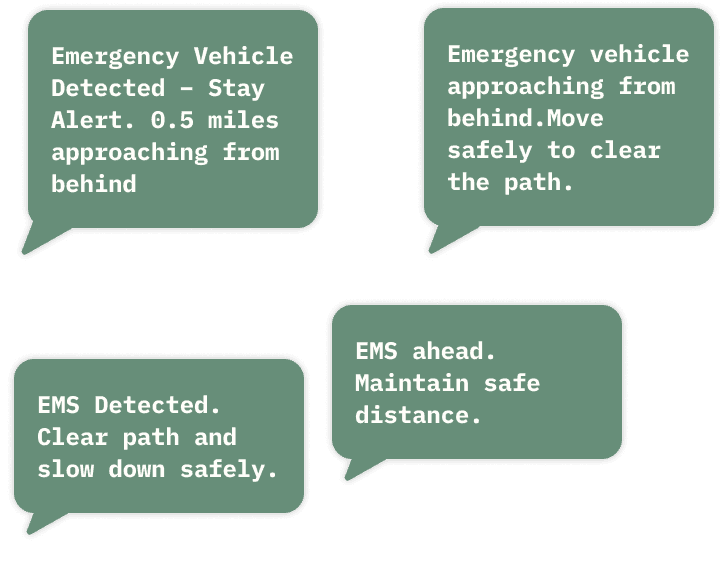
After

Final Prototype
Next Steps

Takeaways
Clear Way transforms a moment of confusion into one of clarity. By integrating multimodal EMS alerts directly into a familiar navigation system, the concept helps drivers respond faster and more confidently in high-pressure situations.
Grounded in research and validated through early testing, the project demonstrates how thoughtful, human-centered design can improve real-world safety while creating a scalable path toward future vehicle integration and smarter urban mobility.